21 – 23 April 2026
Institute of Molecular Genetics, Vídeňská 1083, 142 20, Prague
The international conference Vision for Life – Innovation Days in Bioscience Imaging will bring three
days of intensive knowledge exchange, technological innovation, and hands-on experience in
advanced microscopy and biological imaging to Prague.
The event will take place at the Institute of Molecular Genetics of the Czech Academy of Sciences
(IMG). It is organized by Specion (an authorized distributor of Leica Microsystems) in collaboration
with IMG.
The conference is fully supported by the Light Microscopy Core Facility at IMG, which is part of the
Czech BioImaging national research infrastructure and a member of the Prague node of Euro-
BioImaging, the European research infrastructure for biological and biomedical imaging.
Pavel Hozák, Director of Czech BioImaging, will contribute to the program with a presentation titled “Czech-BioImaging – The National Imaging Platform for All,” introducing the national research infrastructure and its mission to provide open access to state-of-the-art imaging technologies.
The program will feature:
The main keynote speakers of this year’s edition include:
The conference will connect the scientific community, technology partners, and core facility
professionals, creating a platform to discuss current challenges and future directions in bioscience
imaging at both the national and European level.
For any questions regarding the organization of the event, please contact Martin Kopecky (Specion),
main organizer.


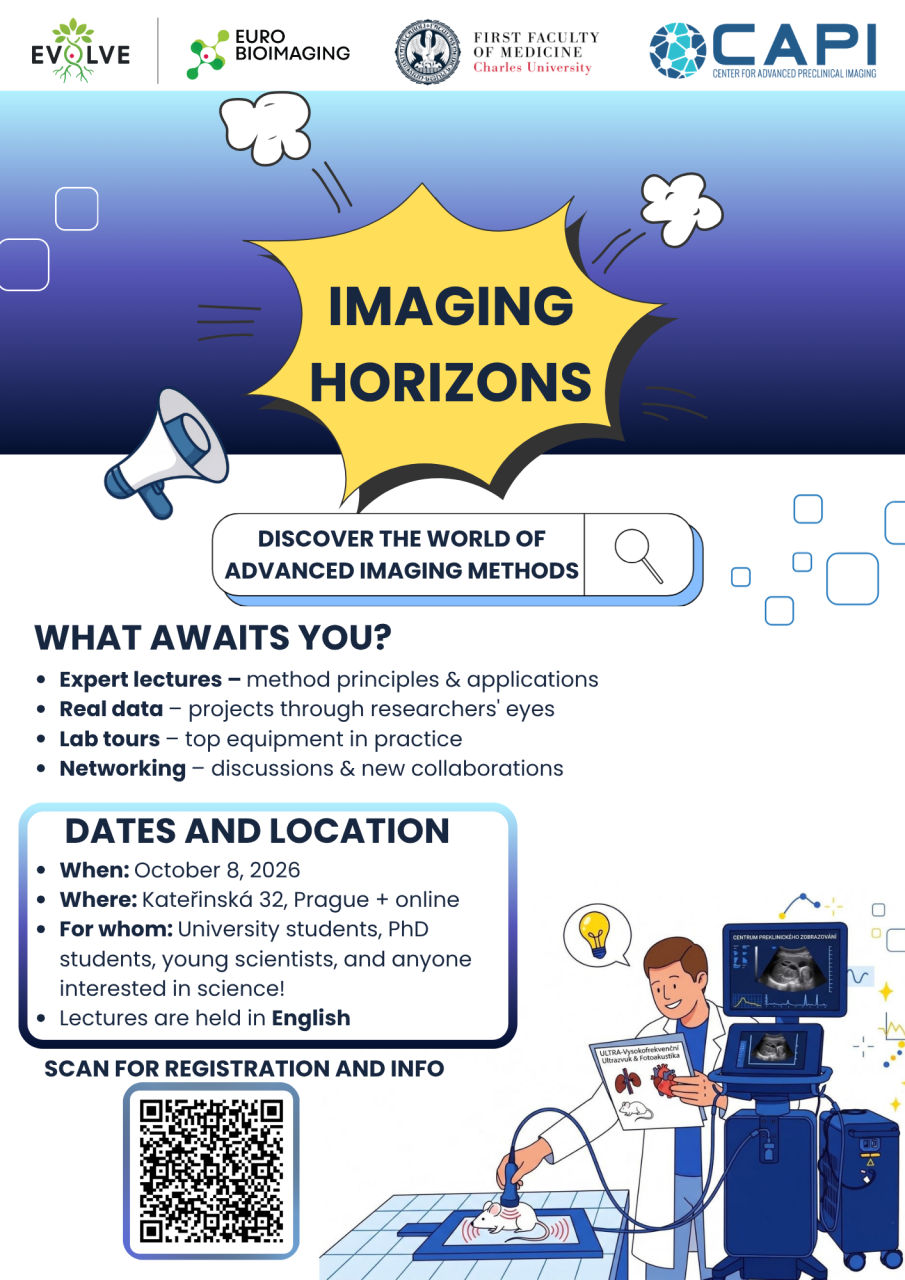
8 October 2026
Kateřinská 32, Praha 2
Language: English
The event “Imaging Horizons”, organized by the Center for Advanced Preclinical Imaging (CAPI) at the First Faculty of Medicine, Charles University, aims to raise awareness of modern imaging methods and their importance for preclinical research. The goal is to present the wide range of technologies available at CAPI, including MRI, PET, CT, ultrasound, photoacoustic imaging, in vivo fluorescence, and magnetic particle imaging, and to demonstrate their practical applications in medicine and biomedicine.
The program combines a 2.5-hour block of expert lectures featuring real data from CAPI projects, followed by a networking session to foster collaboration between participants and experts. The lecture block will be streamed online to enable interactive engagement with a broader audience and increase the event’s reach. Another part of the program consists of guided tours of CAPI laboratories, organized in four sessions (two on the day of the lectures and two on a separate day close to the event date). Participants will be divided into small groups and will learn about measurement principles, sample preparation, instrument demonstrations, and typical data outputs.
The event targets advanced master’s students, PhD candidates, and early-career researchers from medicine, biomedicine, biology, physics, chemistry, and related disciplines. A unique feature of CAPI is its multimodal approach, in-house technology development, and integration into the European Euro-BioImaging infrastructure, which facilitates connections with the international scientific community and supports new collaborations.

7 – 9 December 2026
Institute of Experimental Medicine, Vídeňská 1083, 142 20, Prague
This course is aimed at participants familiar with the basics of image processing, who want to automate their analysis using scripting. We will work with ImageJ macro language and use it to create a workflow for segmentation, batch processing and analysis of fluorescence microscopy images. In the second part of the course, we will introduce Cellpose, a machine learning algorithm for cell segmentation, demonstrate its use through command line and ImageJ plugin, and incorporate its output into the ImageJ workflow.
No previous programming knowledge is expected, and the course will therefore also briefly introduce basic programming concepts, such as variables, for loops and conditionals (if-else statements). Most of the sessions will be hands-on, and the last day will be dedicated to individual consultations of user projects and questions.
The course is primarily aimed at participants with some experience with ImageJ and basic understanding of bioimage analysis. We expect no or minimal knowledge of programming.
Participants are required to bring their own laptop for hands-on exercises. If you do not have access to a laptop, please inform us in advance, and we will provide you with one. Prior to the event, you will receive a list of the required software programs to install for the course.
Please make sure that all required software is installed and works prior to the workshop, especially if your laptop runs macOS or Linux (we work mostly with Windows and are therefore not as familiar with the other operating systems, therefore troubleshooting during the course is difficult).
28 – 29 May 2026
Institute of Experimental Medicine, Vídeňská 1083, 142 20, Prague
This course introduces participants to the fundamentals of volumetric and time-lapse microscopy data processing, with a focus on visualization, segmentation, and quantitative analysis. The first day offers a hands-on introduction to Imaris, covering its core modules (Spots, Surfaces, and Filaments). The second day builds on this and includes a broader discussion on big data challenges, alternative 3D processing tools in ImageJ/Fiji, and options for data storage, sharing, and reuse (FAIR data).
The course is organized in hybrid form and it is possible to join either in-person or online.
Imaris is the main software used, and the course is designed to provide a comprehensive overview of its capabilities. As such, it is primarily aimed at participants with no or limited experience. However, advanced features and exercises will also be included to benefit those already familiar with the software.
24 – 25 November 2026
Building Da I. IPHYS BIF, Krc Campus, Videnska 1083, Prague
Course fee is 40 Euros
The two-day course consists of lectures and hands-on sessions which will demonstrate basic mechanical testing methods such as atomic force microscopy, Brillouin microscopy, indentation test or uniaxial and biaxial tensile test. The tests will be introduced in practical sessions together with their biological and methodological relevance. To relate the mechanical tests to the most significant biomechanical structures such as collagen fibers, elastic fibers or fat, the participants will be taught how to link these mechanical properties and microscopy images. Due to the minimum sample alternations, the images are acquired using label-free techniques, for instance, pSHG, THG or CARS or confocal reflectance microscopy.

2 – 4 December 2026
Institute of Scientific Instruments of the Czech Academy of Sciences, Královopolská 147, Brno, Czech Republic
From sample preparation to imaging and data analysis
Discover what advanced microscopy can bring to your research. Meet our experts, explore our laboratories and gain practical experience with sample preparation, imaging and data analysis. The course is designed for students, early-career researchers and laboratory professionals working in life sciences and soft materials.
Explore microscopy methods and applications, and see the Leica Microsystems UC Enuity ultramicrotome in action.
Join a dedicated Nion UltraSTEM workshop covering measurements and data processing—limited to five participants—or explore 3D data analysis and laboratory sessions in FIB-SEM / SEM-STEM, SEM / EDX / CL and Raman spectroscopy.
Get hands-on experience with HPF and cryo-preparation, see a demonstration of 4D-STEM in SEM, and try hyperspectral imaging. The program also includes a guided tour of other laboratories.
Small-group practical sessions. Limited places—register early!
2 December: Free lectures and live Leica UC Enuity demonstration.
3–4 December: Workshop and laboratory hands-on sessions CZK 1,000
GUEST EXPERTS
Are you a student under 26 with an interest in microscopy? Apply for a scholarship to cover your course registration fee. For more information, e-mail: hrubanova@isibrno.cz
Contact: hrubanova@isibrno.cz

20 – 24 April 2026
First Medical Faculty, Charles University, CAPI, Salmovská 3, 120 00 Prague
Language: Czech
Course for acquiring qualification and professional competence (designing experiments and experimental projects) in the field of experimental animal use according of Act No. 246/1992 On the Protection of Animals Against Cruelty.
Link coming soon
9 – 13 March 2026
First Medical Faculty, Charles University, CAPI, Salmovská 3, 120 00 Prague
Language: English
Course for acquiring qualification and professional competence (designing experiments and experimental projects) in the field of experimental animal use according of Act No. 246/1992 On the Protection of Animals Against Cruelty.
Link coming soon
6-12 September 2026
Centre for Biomedical Image Analysis Faculty of Informatics, Masaryk University, Botanická 68a Brno, 602 00
The summer school is focused on the advanced methods of biomedical image analysis with emphasis on bio- (microscopy) image analysis. The main goal is to make the students familiar with the advanced state-of-the-art techniques of mathematical morphology, image segmentation, object detection and tracking, synthetic image generation, benchmarking, etc. The focus will be on the methodology suitable for multiple applications. Special attention will be paid to the combination of machine learning and classical approaches.
Target groups are Master and Ph.D. students of computer science, mathematics or engineering backgrounds specialized in signal and image processing. Students are supposed to know the basics of signal and image processing, machine learning and have some programming experience in this field. The main activities of the course will be theoretical lectures supplemented by practical examples run on students’ computers.

12-13 + 16-17 February 2026
Imaging Methods Core Facility, BIOCEV, Průmyslová 595, 252 50, Vestec
While the skills learned during the course will have broad applications (data analysis, plotting, scripting…), the focus of exercises will be on image analysis and processing topics. Prior knowledge of digital imaging is helpful but not required.
This course is structured in two parts:
Introductory Session: Tailored for absolute beginners in Python programming. Participants will start with Python installation and basic syntax, progressing to practical exercises focused on working with digital images and relevant libraries for I/O, measurements, ploting and more. Batch processing of multiple images and an intro to Napari (a Python-based interactive image visualization tool) will also be covered.
Advanced Session: This session offers extended hands-on practice, more complex image analysis cases, alternative approaches, and the use of AI tools such as Cellpose for segmentation. This session builds on python skills from the first session. It is ideal for those who completed the introductory session, but also open to participants with basic Python experience. The ability to set up and run a working Python environment is a prerequisite.
Applicants may register for either part or both.
10 – 13 November 2026
Imaging Methods Core Facility, BIOCEV, Průmyslová 595, 252 50, Vestec
Hands-on training on selected time-resolved experimental techniques and data analysis, commonly called Fluorescence Lifetime Imaging Microscopy.
The course focuses on explaining the principles of nano-second time-resolved fluorescence detection, on demonstration of different hardware realizations, on trying various applications of FLIM in biological imaging and on testing of several ways of FLIM data analysis.The aim is to uncover the richness of information hidden in multiparametric fluorescence imaging and to inspire the participants to use the easily obtainable extra contrast in their imaging applications. An important part is to make the FLIM data analysis understandable.
Testing of your own samples is available anytime after (or even before) the FNOB course upon agreement with IMCF staff (may be a subject to instrument fees).
8 – 10 June 2026
Institute of Molecular Genetics, Vídeňská 1083, 142 20, Prague
The three-day course is designed as an intensive hands-on training focused on modern super-resolution microscopy methods and their practical application in biological research. Participants will work directly with advanced imaging systems and create real datasets, gaining practical experience with several super-resolution approaches.
The program combines introductory lectures with extended practical sessions in small groups. The practical part will focus on SIM, SMLM, STED, and optical reassignment approaches, together with data processing and reconstruction workflows. Participants will also learn how to evaluate the suitability of different super-resolution techniques for specific biological questions.
In addition to the technical training, the course will include scientific lectures presenting real biological applications of super-resolution microscopy, providing context for the methods demonstrated during the practical sessions.
The course is open to an international audience of PhD students, postdoctoral researchers, and imaging facility staff interested in advanced light microscopy methods.