1-4 December 2026
To Be Announced
This comprehensive course is designed specifically for biologists to master cutting-edge image analysis software. It covers both the theory of image processing and its practical applications, focusing on precise and efficient image quantification, segmentation, and visualization techniques. Participants will gain hands-on experience with industry-leading commercial and open-source tools and elevate their data analysis skills to the next level.
The course also introduces the FAIR principles for scientific data and demonstrates effective strategies for data management using the OMERO database.
The course is organised by the Cellular Imaging Core Facility in collaboration with the Faculty of Informatics, Masaryk University.


8-11 September 2026
CEITEC MU, University Campus, Building C02, CELLIM CF, Brno
The Advanced Light Microscopy Methods is an advanced course for students, postdocs, technicians, and other laboratory staff in biology and biomedical science who require specialised microscopy methods for their experiments. The course consists of theoretical lectures (25%) and practical hands-on sessions on selected microscopes (50%) and image processing software (25%).
Overall, this course provides an overview of core principles behind super-resolution, FLIM-FRET and mesoscopic imaging methods, together with corresponding essential image processing steps. Participants will learn theoretical principles behind large sample imaging, super-resolution methods like Airyscan, Optical Reassignment, Structured Illumination and Single Molecule Localisation, as well as Fluorescence Lifetime and Förster Resonance Energy Transfer Microscopy.
A dedicated practical session will demonstrate the learned principles directly on real microscope acquisitions. Participants will gain skills needed to operate selected microscopes and experience how to setup advanced experimental workflow, and perform the most common troubleshooting.
The workshop concludes with an overview of related workflows in image processing and analysis utilising related software (ZEN, LAS X). Finally, the participants will receive comprehensive guidelines for advanced analysis and image visualisation in Imaris.
Practical training will be conducted on the following systems:
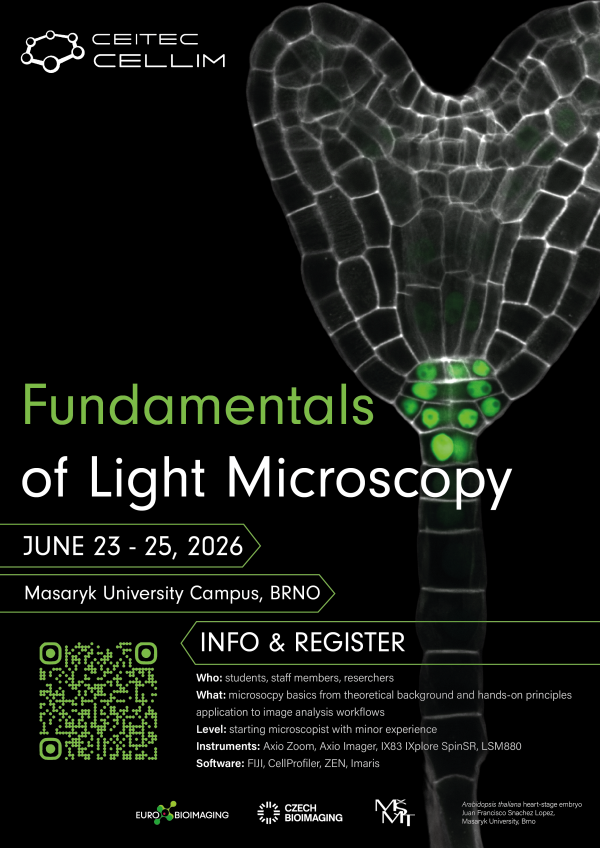
23-25 June 2026
CEITEC MU, University Campus, Building C02, CELLIM CF, Brno
The Fundamentals of Light Microscopy is a basic course for students, postdocs, technicians, and other laboratory staff in biology and biomedical science who require widefield and/or confocal microscopy for their experiments. The course consists of theoretical lectures (50%) and practical hands-on session on selected microscopes and software (50%).
Overall, this course provides an introduction to the fundamentals of light microscopy, with a focus on understanding how images are formed and how acquisition choices affect resolution, contrast, and quantitative image quality. Participants will learn core principles including diffraction and the point spread function, numerical aperture and refractive index effects, sampling and digitization, detector characteristics and noise, and the conceptual differences between major imaging modalities such as widefield, confocal, super-resolution and light sheet microscopy.
A dedicated practical session will demonstrate the learned principles directly on real microscope acquisitions. Participants will gain skills needed to operate selected microscopes and experience how changing parameters influences contrast, optical sectioning, signal-to-noise ratio, and artifacts.
Finally, the workshop concludes with an introduction to basic workflows in image processing and analysis, including foundational steps for viewing, correcting, and preparing microscopy datasets for downstream quantification using open-source and commercial tools (FIJI/ImageJ, CellProfiler, ZEN, Imaris).
8 – 13 October 2026
First Medical Faculty, Charles University, CAPI, Salmovská 3, 120 00 Prague
Language: English
The event “Imaging Horizons”, organized by the Center for Advanced Preclinical Imaging (CAPI) at the First Faculty of Medicine, Charles University, aims to raise awareness of modern imaging methods and their importance for preclinical research. The goal is to present the wide range of technologies available at CAPI, including MRI, PET, CT, ultrasound, photoacoustic imaging, in vivo fluorescence, and magnetic particle imaging, and to demonstrate their practical applications in medicine and biomedicine.
The program combines a 2.5-hour block of expert lectures featuring real data from CAPI projects, followed by a networking session to foster collaboration between participants and experts. The lecture block will be streamed online to enable interactive engagement with a broader audience and increase the event’s reach. Another part of the program consists of guided tours of CAPI laboratories, organized in four sessions (two on the day of the lectures and two on a separate day close to the event date). Participants will be divided into small groups and will learn about measurement principles, sample preparation, instrument demonstrations, and typical data outputs.
The event targets advanced master’s students, PhD candidates, and early-career researchers from medicine, biomedicine, biology, physics, chemistry, and related disciplines. A unique feature of CAPI is its multimodal approach, in-house technology development, and integration into the European Euro-BioImaging infrastructure, which facilitates connections with the international scientific community and supports new collaborations.
Link coming soon

2 – 4 December 2026
Institute of Experimental Medicine, Vídeňská 1083, 142 20, Prague
This course is aimed at participants familiar with the basics of image processing, who want to automate their analysis using scripting. We will work with ImageJ macro language and use it to create a workflow for segmentation, batch processing and analysis of fluorescence microscopy images. In the second part of the course, we will introduce Cellpose, a machine learning algorithm for cell segmentation, demonstrate its use through command line and ImageJ plugin, and incorporate its output into the ImageJ workflow.
No previous programming knowledge is expected, and the course will therefore also briefly introduce basic programming concepts, such as variables, for loops and conditionals (if-else statements). Most of the sessions will be hands-on, and the last day will be dedicated to individual consultations of user projects and questions.
The course is primarily aimed at participants with some experience with ImageJ and basic understanding of bioimage analysis. We expect no or minimal knowledge of programming.
Participants are required to bring their own laptop for hands-on exercises. If you do not have access to a laptop, please inform us in advance, and we will provide you with one. Prior to the event, you will receive a list of the required software programs to install for the course.
Please make sure that all required software is installed and works prior to the workshop, especially if your laptop runs macOS or Linux (we work mostly with Windows and are therefore not as familiar with the other operating systems, therefore troubleshooting during the course is difficult).
28 – 29 May 2026
Institute of Experimental Medicine, Vídeňská 1083, 142 20, Prague
This course introduces participants to the fundamentals of volumetric and time-lapse microscopy data processing, with a focus on visualization, segmentation, and quantitative analysis. The first day offers a hands-on introduction to Imaris, covering its core modules (Spots, Surfaces, and Filaments). The second day builds on this and includes a broader discussion on big data challenges, alternative 3D processing tools in ImageJ/Fiji, and options for data storage, sharing, and reuse (FAIR data).
The course is organized in hybrid form and it is possible to join either in-person or online.
Imaris is the main software used, and the course is designed to provide a comprehensive overview of its capabilities. As such, it is primarily aimed at participants with no or limited experience. However, advanced features and exercises will also be included to benefit those already familiar with the software.
24 – 25 November 2026
Building Da I. IPHYS BIF, Krc Campus, Videnska 1083, Prague
Course fee is 40 Euros
The two-day course consists of lectures and hands-on sessions which will demonstrate basic mechanical testing methods such as atomic force microscopy, Brillouin microscopy, indentation test or uniaxial and biaxial tensile test. The tests will be introduced in practical sessions together with their biological and methodological relevance. To relate the mechanical tests to the most significant biomechanical structures such as collagen fibers, elastic fibers or fat, the participants will be taught how to link these mechanical properties and microscopy images. Due to the minimum sample alternations, the images are acquired using label-free techniques, for instance, pSHG, THG or CARS or confocal reflectance microscopy.

1 – 4 December 2026
Institute of Scientific Instruments of the Czech Academy of Sciences, Královopolská 147, Brno, Czech Republic
The three/four-day (TBD) course organized by the ISI EM team at the Institute of Scientific Instruments of the Czech Academy of Sciences will offer students and young researchers in the fields of life sciences and soft materials both theoretical and practical training in electron microscopy and Raman spectroscopy. Participants will gain hands-on experience with SEM and FIB-SEM microscopes, biological sample preparation, EDX analysis, and cryo-SEM workflow. The program will combine introductory lectures with intensive hands-on sessions in small groups and will be complemented by a social evening and discussion sessions at the end of each day.
Link coming soon

20 – 24 April 2026
First Medical Faculty, Charles University, CAPI, Salmovská 3, 120 00 Prague
Language: Czech
Course for acquiring qualification and professional competence (designing experiments and experimental projects) in the field of experimental animal use according of Act No. 246/1992 On the Protection of Animals Against Cruelty.
Link coming soon
9 – 13 March 2026
First Medical Faculty, Charles University, CAPI, Salmovská 3, 120 00 Prague
Language: English
Course for acquiring qualification and professional competence (designing experiments and experimental projects) in the field of experimental animal use according of Act No. 246/1992 On the Protection of Animals Against Cruelty.
Link coming soon
6-12 September 2026
Centre for Biomedical Image Analysis Faculty of Informatics, Masaryk University, Botanická 68a Brno, 602 00
The summer school is focused on the advanced methods of biomedical image analysis with emphasis on bio- (microscopy) image analysis. The main goal is to make the students familiar with the advanced state-of-the-art techniques of mathematical morphology, image segmentation, object detection and tracking, synthetic image generation, benchmarking, etc. The focus will be on the methodology suitable for multiple applications. Special attention will be paid to the combination of machine learning and classical approaches.
Target groups are Master and Ph.D. students of computer science, mathematics or engineering backgrounds specialized in signal and image processing. Students are supposed to know the basics of signal and image processing, machine learning and have some programming experience in this field. The main activities of the course will be theoretical lectures supplemented by practical examples run on students’ computers.
12-13 + 16-17 February 2026
Imaging Methods Core Facility, BIOCEV, Průmyslová 595, 252 50, Vestec
While the skills learned during the course will have broad applications (data analysis, plotting, scripting…), the focus of exercises will be on image analysis and processing topics. Prior knowledge of digital imaging is helpful but not required.
This course is structured in two parts:
Introductory Session: Tailored for absolute beginners in Python programming. Participants will start with Python installation and basic syntax, progressing to practical exercises focused on working with digital images and relevant libraries for I/O, measurements, ploting and more. Batch processing of multiple images and an intro to Napari (a Python-based interactive image visualization tool) will also be covered.
Advanced Session: This session offers extended hands-on practice, more complex image analysis cases, alternative approaches, and the use of AI tools such as Cellpose for segmentation. This session builds on python skills from the first session. It is ideal for those who completed the introductory session, but also open to participants with basic Python experience. The ability to set up and run a working Python environment is a prerequisite.
Applicants may register for either part or both.